
If you’ve never made Caponata, you need to fix that immediately. It may sound intimidating, but it looks fantastic on the table, and it tastes even better. At its core, it’s a Sicilian eggplant stew— though my Nonna from Calabria made this side dish all the time. It’s been in my family for as long as I can remember. Vegetables are slow-cooked with tomato sauce, then finished with capers and olives for a signature briny, tangy kick. It’s sweet, savory, and even a little sour. But, trust me, it tastes phenomenal.
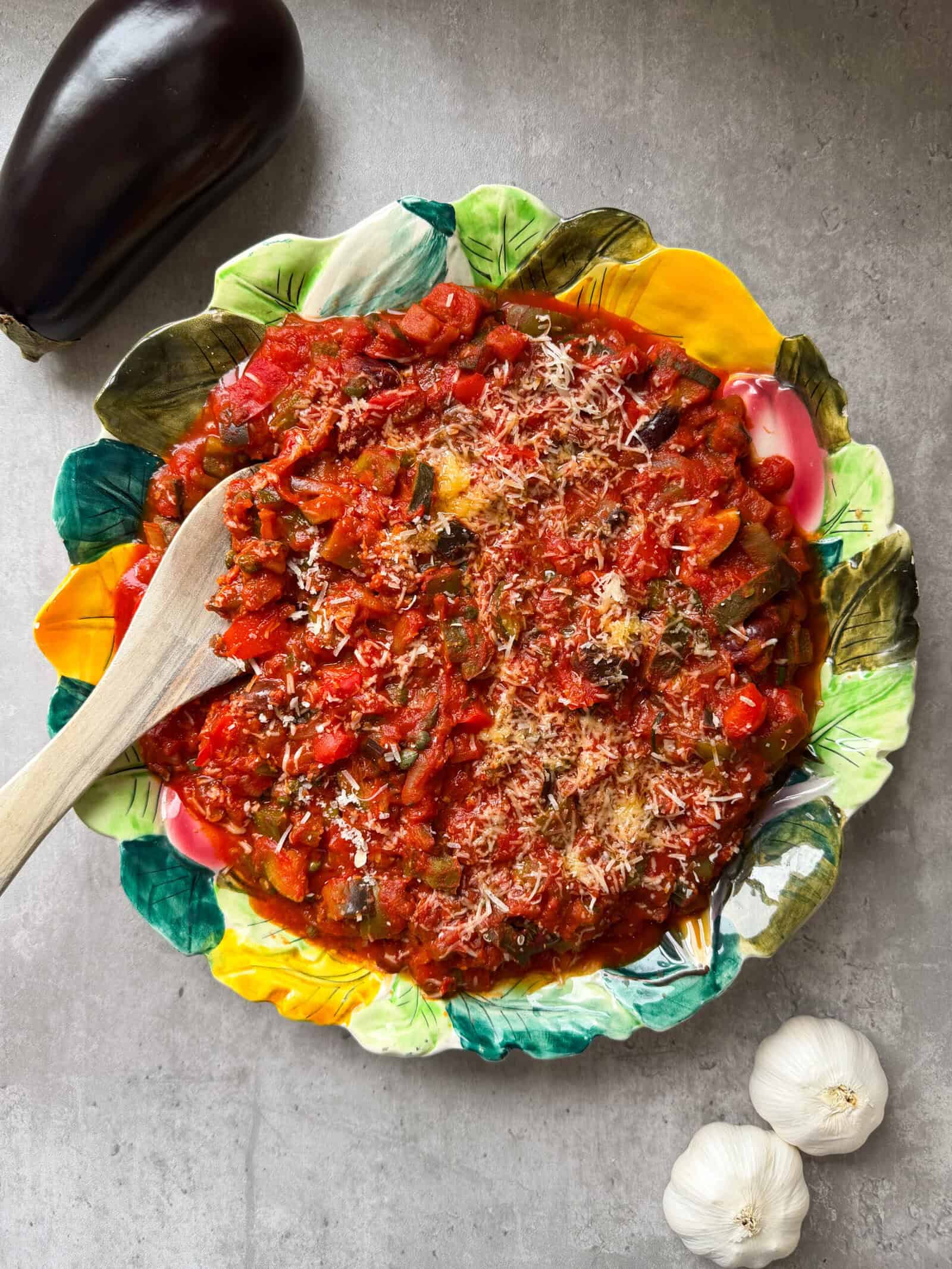
Caponata is sweet, tangy, briny, and so savory all at once, and because it’s all done in one pan on the stovetop, there’s barely any cleanup to deal with. It works as a side dish, a dip, a pasta sauce—honestly whatever you need it to be. Want more eggplant recipes? Try my Eggplant Salad, Eggplant Parmigiana, or Stuffed Eggplant.
😍 Why You’ll Love This Caponata Recipe
It gets better the next day: Make it the night before and you’ll be shocked how much the flavors improve after sitting overnight.
It’s mostly just chopping: Once everything is in the pan, you’re basically just stirring occasionally and waiting. No stress to this recipe at all!
It goes with everything: Bread, pasta, grilled meat, on its own—it’s a recipe that just works no matter what you pair it with.
The capers and olives are everything: They go in at the end but they’re what makes the whole dish taste amazing.
🍆 Ingredients Needed to Make This Caponata Recipe
Olive oil: Use a good extra virgin here—you’re infusing it with garlic and red pepper flakes right at the start, so the quality matters.
Garlic cloves: They gently perfume the oil and the whole dish as it cooks, then get removed at the end so you get the flavor without the bite.
Eggplant: Partially peeled in a zebra pattern, which helps it hold its shape instead of turning into mush. Cube it into similar-sized pieces so it cooks evenly with the rest.
Zucchini: Adds a soft, mild sweetness that balances out the stronger flavors in the dish.
Celery: A classic caponata ingredient, it adds a subtle crunch and an earthy note.
Yellow onion: Sliced and slow-cooked until completely soft and almost jammy.
Red and green peppers: They add color and sweetness. Using both gives you a more complex, layered flavor than just one alone.
Tomato sauce: Use a good quality one—something like Mutti or San Marzano. The sauce is the backbone of this dish, so it’s worth reaching for the good stuff.
Kalamata olives: Roughly chopped and stirred in near the end so they stay intact and bring that punchy, briny flavor.
Capers: Also added at the end so they hold their texture and give you little bursts of salt and tang in every bite.
Fresh basil: Stirred in with the tomato sauce for brightness.
Red pepper flakes: Bloomed in the oil right at the start.
Parmigiano Reggiano: Grated over the top at the end.
Salt: Season as you go, and taste before serving—the olives, capers, and parm all bring their own saltiness, so go easy until the end.
✔ How To Make This Caponata Recipe
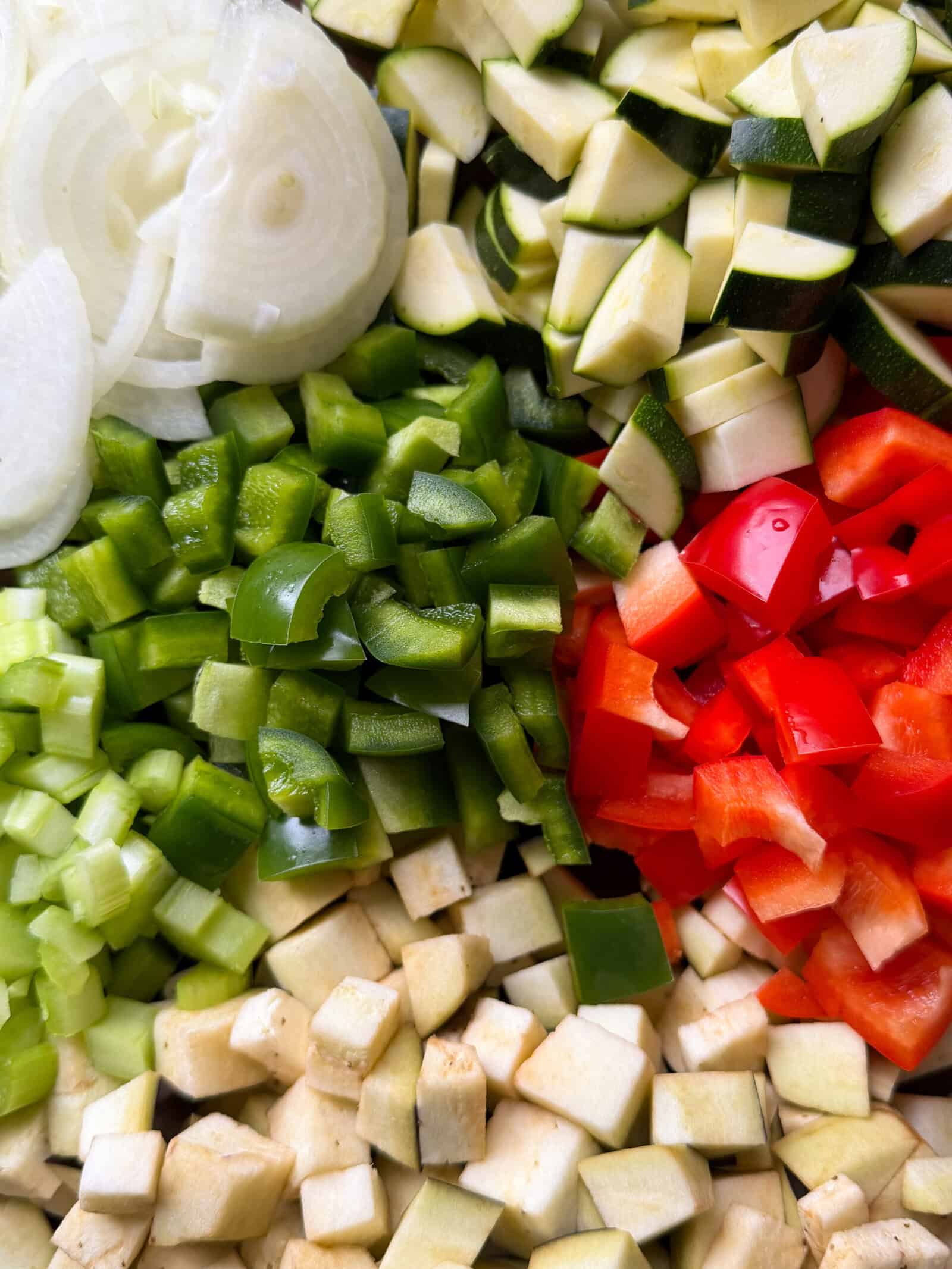
Begin by chopping all of the vegetables. Partially peel the eggplant, removing strips of skin in a zebra pattern – this helps the eggplant keep its shape and stay slightly firm while cooking.
To a large deep pan, set to medium heat, add the olive oil, whole garlic cloves and red pepper flakes and allow to sauté for about a minute, just so that the oil becomes infused.
Add all of the vegetables to the pan (don’t add the olives or capers just yet) and reduce the heat to medium-low. Stir well so the oil evenly coats all of the vegetables. Partially cover the pan with a lid (about 75% covered) and cook for 20–25 minutes, stirring often. You’ll notice the vegetables begin to release liquid as they cook -this is exactly what you want.If the pan becomes too dry at any point, add about 2 tablespoons of water to help maintain the stewing process. You’ll know the vegetables are ready when they are tender and softened.
🤝 Sammy’s Tips for This Caponata Recipe
- Cut the vegetables into similar-sized pieces, about ¼-inch thick, so they cook evenly.
Once the vegetables are tender and softened, add the tomato sauce, red wine vinegar, and fresh basil. Stir to combine, then bring the mixture to a gentle simmer. Partially cover the pan with a lid and let simmer for 15–20 minutes, stirring occasionally. During the last 5 minutes of cooking time, add the olives and capers then remove the whole pieces of garlic and discard.
Taste to see if it needs additional salt before removing from the heat.
Transfer to a serving dish, garnish with parmigiano reggiano and serve right away.
🗒 Variations
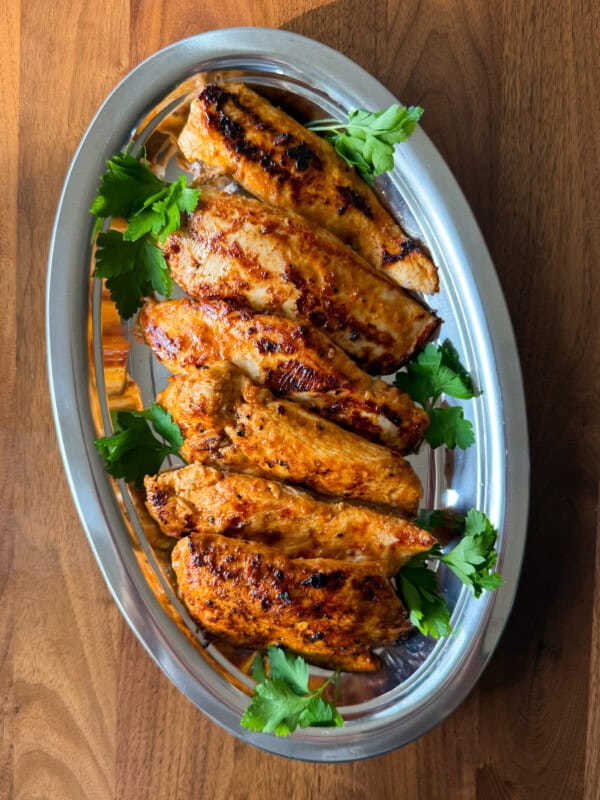
Add protein: Stir in some shredded rotisserie chicken along with the tomato sauce for a heartier version that works well as a main.
Add carrots: They hold up well during the long cook and add a gentle sweetness—just chop them to the same size as everything else.
More heat: If you like things spicier, double the red pepper flakes or add a small dried chili to the oil at the start.
🗒 Substitutions
Tomato sauce: A good quality jarred sauce is important here. I use Mutti or San Marzano and the results are always great.
Kalamata olives: Green olives work if that’s what you have, though they’re a little milder in flavor.
Capers: If you’re not a caper fan, just leave them out—the dish is still great without them.
Zucchini: Yellow squash is a perfect swap and behaves exactly the same way in the pan.
🍴 Leftovers? Lucky You.
Store leftovers in an airtight container in the fridge for up to four days. Caponata is a dish that improves overnight as the flavors have time to sit together. To reheat, warm it in a small pan over medium-low heat until heated through, or microwave it in 30-second intervals, stirring in between.
🤔 FAQs
Can caponata be frozen?
Yes—it freezes really well for up to 3 months. Let it cool completely, transfer to a freezer-safe container, and thaw overnight in the fridge before reheating.
Can I make it the day before?
Yes! It tastes even better after a night in the fridge. Just reheat gently before serving.
Can I add other vegetables?
Yes — carrots are a great addition and are traditional in many versions. Just cut them small so they cook at the same rate as everything else.
What tomato sauce do you recommend?
Reach for a good quality sauce—Mutti and San Marzano are both excellent choices. Since the sauce is a major component of this dish, a better sauce makes a noticeable difference in the final result.
What do I serve it with?
Crusty bread is perfect, but it’s also great over pasta, alongside grilled fish or chicken, or spooned onto crostini as an appetizer.
👩🏻🍳 Hungry For More?
If you loved this Caponata recipe, then make sure to check out a few of my other eggplant recipes you may also love:
💌 Let’s Stay Connected
Keep in touch with me on Instagram, TikTok, Facebook, and Pinterest! If you do make this caponata recipe (or any recipe of mine) don’t forget to leave a review.
Caponata
Equipment
- 1 deep frying pan with lid
Ingredients
- 3 tbsp olive oil, extra virgin
- 2 garlic cloves, whole, peeled
- 1/2 cup parmigiano reggiano, grated
- 3 cups tomato sauce, I use a 680mL jar
- 1/4 cup red wine vinegar
- 1 eggplant, cubed
- 2 zucchini, cubed
- 2 stalks of celery, chopped
- 1 yellow onion, sliced
- 1 red pepper, cubed
- 1 green pepper, cubed
- 2 tbsp capers
- 1/4 cup kalamata olives, chopped
- 2 tbsp fresh basil, finely chopped
- 1 tsp salt
- 1 tsp red pepper flakes
Instructions
- Begin by chopping all of the vegetables. Partially peel the eggplant, removing strips of skin in a zebra pattern – this helps the eggplant keep its shape and stay slightly firm while cooking.Sammy's tip: cut the vegetables into similar-sized pieces, about ¼-inch thick, so they cook evenly.
- To a large deep pan, set to medium heat, add the olive oil, whole garlic cloves and red pepper flakes and allow to sauté for about a minute, just so that the oil becomes infused.
- Add all of the vegetables to the pan (don't add the olives or capers just yet) and reduce the heat to medium-low. Stir well so the oil evenly coats all of the vegetables. Partially cover the pan with a lid (about 75% covered) and cook for 20–25 minutes, stirring often.You’ll notice the vegetables begin to release liquid as they cook -this is exactly what you want.If the pan becomes too dry at any point, add about 2 tablespoons of water to help maintain the stewing process.You’ll know the vegetables are ready when they are tender and softened.
- Once the vegetables are tender and softened, add the tomato sauce (then add about 1/3 cup of water to the tomato jar, shake it it to get all of the sauce out, then pour that into the pan), red wine vinegar, and fresh basil. Stir to combine, then bring the mixture to a gentle simmer. Partially cover the pan with a lid and let simmer for 15–20 minutes, stirring occasionally. During the last 5 minutes of cooking time, add the olives and capers then remove the whole pieces of garlic and discard.
- Taste to see if it needs additional salt before removing from the heat.
- Transfer to a serving dish, garnish with parmigiano reggiano and serve right away.
Nutrition
Nutrition information is automatically calculated, so should only be used as an approximation.


My family loved this!
Adding red wine vinegar with Grandma Panetta in my heart! What is the measurement?
Hi Megan, sorry for the miss on the recipe, I have now amended. You will need 1/4 cup of red wine vinegar.
Cheers to Grandma Panetta 🙂
– Sammy
My family loved this! It’s a delicious recipe, which works exactly as described. I added shredded chicken and next time I will add a few more chilli flakes which I was a bit shy with initially. For a main meal, it went to 4-5 portions with 2 large chicken breasts added.
Hi Charlotte, thanks for taking the time to send in a review. Glad you family enjoyed it.
– Sammy
Thanks for this! I’ve been looking for Calabrian recipes! My husband’s fam immigrated to Canada from there but family recipes didn’t come with. This looks fantastic and I can’t wait to try it 🙂
He Dawne, I hope you enjoy it, let me know if it was a sucess or not.
– Sammy
So delicious! Had to make it without the olives and capers as I have a couple of people in my family that won’t eat them but was still yummy. Everyone had seconds. Going to make it as a pasta sauce for Easter. Will puree a couple of portions for my guests that don’t like their veggies so they will still get all the goodness of this recipe!
Hi Angela, so glad you enjoyed the Caponata. Good idea on blending some of the vegetables, I am sure it turned out great.
– Sammy